Showing posts with label Apologetics. Show all posts

Thursday, April 17, 2025

Grok Weighs in on Easter


The strongest argument supporting the historicity of Jesus' resurrection is that it provides the most compelling explanation for a set of widely accepted historical facts: the discovery of the empty tomb, the reported post-resurrection appearances of Jesus to his followers, and the sudden transformation of his disciples. Below, I’ll break down why this argument holds significant weight.

The Cross & the Tomb

Key Historical Facts

The Empty Tomb
The New Testament accounts claim that Jesus’ tomb was found empty shortly after his crucifixion. This is significant because, in the first-century Jewish context, a messiah who was crucified would have been seen as a failure  —  yet his followers proclaimed his resurrection. If the body had remained in the tomb, opponents of early Christianity, such as the religious authorities or Roman officials, could have easily disproved the resurrection by producing it. The absence of such counterevidence suggests the tomb was indeed empty.

Post-Resurrection Appearances
Multiple accounts in the New Testament describe Jesus appearing to various individuals and groups after his death, including the disciples, women followers, and even skeptics like Paul (who later became a key Christian leader). These reports span different times and locations, making it harder to dismiss them as a single, isolated incident. While critics might suggest these were hallucinations, the variety and number of witnesses complicate such an explanation.

Transformation of the Disciples
After Jesus’ crucifixion, his disciples were depicted as fearful and scattered, hiding from authorities. Yet, within weeks, they became bold proclaimers of his resurrection, willing to face persecution and death. This dramatic shift is striking  —  what could account for such a change if not an extraordinary event they genuinely believed in?

Why the Resurrection Explains These Facts

The resurrection hypothesis ties these elements together into a coherent narrative:

  • The empty tomb is explained as the result of Jesus rising from the dead, rather than requiring alternative theories like body theft (which lacks evidence) or the disciples’ mistake (unlikely given the tomb’s specific location).
  • The appearances align with the claim that Jesus was alive again, interacting with his followers in a tangible way, rather than being mere visions or delusions shared across diverse groups.
  • The disciples’ transformation makes sense if they witnessed something as profound as their leader returning from death, giving them unshakable conviction in their message.

Challenges to Alternative Explanations

Critics often propose naturalistic alternatives, but these struggle to account for all the facts:

  • Theft of the Body: Who would have taken it, and why? The disciples lacked motive (they were risking their lives), and enemies would have produced the body to stop the movement.
  • Hallucinations: Mass hallucinations are rare and don’t explain the empty tomb or the consistency of the appearances across different settings.
  • Fabrication: The early Christians’ willingness to die for their belief, combined with details like women (whose testimony was undervalued in that culture) being the first witnesses, suggests the story wasn’t a calculated invention.

Cultural Context

In first-century Judaism, the idea of a single person rising from the dead before the general resurrection at the end of time was unexpected. For a movement to emerge around a crucified leader — proclaiming him as risen — defied cultural and religious norms, adding to the argument that something extraordinary must have sparked it.

Conclusion

While the historicity of the resurrection remains a matter of debate and interpretation, its strength as an argument lies in its explanatory power. The convergence of the empty tomb, the post-resurrection appearances, and the disciples’ radical transformation presents a historical puzzle that the resurrection hypothesis addresses more effectively than competing theories. For those open to its possibility, it stands as a robust case for the event’s reality, grounded in the origins and rapid spread of early Christianity.

*  *  *  *  *  *  *

X's artificial intelligence engine, Grok, wrote this post to answer the question "What's the strongest argument for the historicity of the resurrection of Jesus?" I then asked it to come up with a concluding "Truth is..." statement. What it wrote is more hippyish than I normally publish, but it's not bad:

Truth is...the resurrection of Jesus stands as a beacon of hope and mystery, inviting us to consider the extraordinary possibility that love and life transcend even death itself.


Thursday, September 5, 2024

Everybody's Headed to Hell


Previously (as in last week) on Truth Is...

"It's kind of amazing that even though Jesus has every right to rule with an iron fist, he chooses to persuade and call; to open the door and invite."

I made that statement last week, and I repeat it today, fully confident that there are many who think I'm full of beans. They simply do not picture Jesus giving a gentle invitation. Instead, they characterize God as an egotistical despot who sends people to hell if they don't believe in him . . . while refusing to give any undeniable proof that he exists.

An angry god

Well, let's just back up a second.

I would contend that God doesn't send ANYone to hell. Hell is the default destination of all those who sin. And the list of "all those who sin" includes the names of everyone who has ever lived except Jesus.

God doesn't have to take any action at all for a human soul to wind up completely separated from his perfection, which is the state of existence that we call hell.

That's pretty bad news.

The good news is that not only did God NOT do nothing, but he in fact went to great lengths to pave a path that leads directly to eternal bliss in his presence, which is the state of existence that we call heaven.

*  *  *  *  *  *  *

Truth is...rather than sending people to hell, Yahweh sends people to heaven; a gracious gift made possible by the death and resurrection of Jesus of Nazareth. It's a gift we must choose to receive. It's an invitation we must RSVP to.


Thursday, August 31, 2023

Proof of God


Calvin and Hobbes are relaxing on a hillside, and out of the blue, Hobbes asks probably the most important question ever.


Calvin thinks a moment and then comes up with a totally unique bit of apologetics.


Believe it or not, Calvin is right. God IS out to get him. And he's out to get each of US, too.

No, not in the way Calvin is thinking about it. God is not the Great Cosmic Killjoy chasing us down to inflict wrath on anyone who dares to step out of line...or color outside the lines. But he IS pursuing us with a heart full of lavish love and amazing grace. "Not wanting anyone to perish." (2nd Peter 3:9)

Borrowing from an 1890 poem by Francis Thompson, Yahweh has been called "The Hound of Heaven" because of his relentless pursuit of those he loves...in other words, us. And make no mistake about it, none of us can hide from him for long.

"Can anyone hide from me in a secret place? Am I not everywhere in all the heavens and earth?” says the Lord. (Jeremiah 23:24 NLT)

*  *  *  *  *  *  *

Truth is...The prime example of God being out to get us is that he left the glory of heaven to become a man, perfectly live his life, then die to pay the debt for us NOT perfectly living ours.


Thursday, July 20, 2023

Using Science to Explain Scripture


Previously on Truth is... I have tried to express a certain correlation between a popular scientific theory and a Scriptural text, with perhaps less-than-stellar results. In an attempt to allow science to give it a shot, I gave ChatGPT the following instruction: "Explain the connection between the scientific concept of dark matter and Colossians 1:17."

This is the result of that exercise.


Colossians 1:17 is a biblical verse that states, "He is before all things, and in him all things hold together." This verse is often interpreted to refer to God's role in sustaining the universe and maintaining its order.

On the other hand, dark matter is a scientific concept that describes an invisible form of matter believed to make up a significant portion of the total mass in the universe. Although it does not interact directly with light or other electromagnetic radiation, its presence is inferred from its gravitational effects on visible matter and the structure of the cosmos.

The connection between Colossians 1:17 and dark matter lies in the idea that both concepts point to an underlying force or presence that holds the universe together. While Colossians 1:17 attributes this role to a divine being (God), dark matter is proposed by scientists as a potential explanation for the gravitational forces that shape galaxies and galaxy clusters.

Although it's important to note that these are two distinct perspectives—one theological and the other scientific—they both touch upon the mysterious nature of the universe and the fundamental forces that govern its existence.

*  *  *  *  *  *  *

Truth is...I'm not sure I could say it any better, other than to add that both perspectives involve exercising faith.


Thursday, June 8, 2023

This Title Is a Lie


Once upon a time, there was a "movement" that started in the realm of art that espoused the absence of meaning in everything it created. It was called "Dadaism".

"A state of mind rather than a literary or artistic movement, according to its spokesman the Romanian poet Tristan Tzara (1886-1963), Dada was anarchic, nihilistic, and disruptive. Dadaists mocked all established values, all traditional notions of good taste in art and literature, the culture symbols of a society based, they believed, on greed and materialism and now in its death agony. The name Dada -- a nonsense, baby-talk word -- means nothing, so was well suited to Dada's wholly negative nature. Dada even denied the value of art, hence its cult of non-art, and ended by negating itself. 'The true Dadaist is against Dada.'" [Hugh Honour and John Fleming, in The Visual Arts: A History]


The self-negating nature of Dadaism causes me to think about certain statements:

  • "There is no absolute truth." (So...is that absolutely true?)
  • "People have no right to judge one another." (Usually spoken by someone who has determined, i.e., judged, that someone was being judgy.)
  • "Nobody can be totally sure about anything." (Are you sure about that?)

And what about the title of this post: "This Title Is a Lie"? If that's true, then it's a lie, but then that would mean it was true by being a lie...but if it's a lie that would make it true, which would make it NOT a lie, which would make it a lie...

*  *  *  *  *  *  *

Truth is...It's not that hard to confound a human's mind. Kinda makes it easy for me to believe Isaiah 55:8-9. “My thoughts are nothing like your thoughts,” says the Lord. “And my ways are far beyond anything you could imagine. For just as the heavens are higher than the earth, so my ways are higher than your ways and my thoughts higher than your thoughts."


Thursday, November 17, 2022

It Doesn't HAVE To Be Science Or Faith


I recently started reading a book by a couple of Jesuit priests who work at the Vatican observatory (Guy Consolmagno and Paul Mueller). It's titled Would You Baptize an Extraterrestrial? and its first chapter gives a great analogy that explains how science and religion don't have to be at odds with each other.

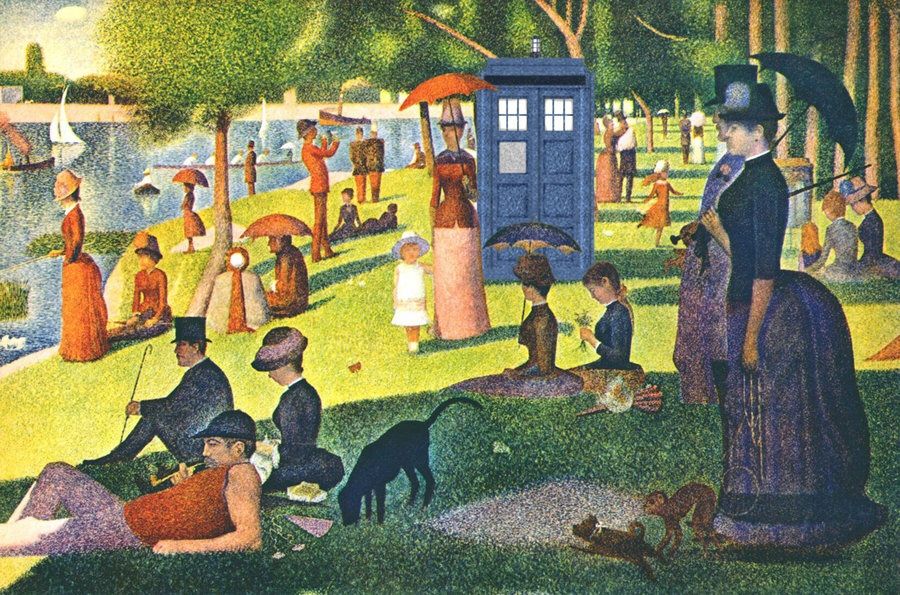
One piece of background explanation: the painting that is referenced in this quote was not painted with brushstrokes of paint, but was created using a technique called pointillism, where the image was built up by adding colors dot by dot, much like the digital imaging techniques used today.


When I look at A Sunday on La Grande Jatte  -  1884, I keep flipping back and forth between seeing the whole scene, which is lots of people enjoying a beautiful day in the park, and seeing the little dots from which that scene is made up. But to me that doesn't mean the world is falling apart  -  it means that there is more than one way to see the world. One way is to see the big picture, the everyday world of common experience. Another way is to see the world as analyzed by science: a world of tiny atoms, of particles and waves, of fields of force  -  a world that can be described mathematically.

That's one way to get at relating science and faith: think of it as flipping back and forth between two different ways of seeing one and the same world. We can see the world through the eyes of science or through the eyes of faith.

When you see the world through the eyes of faith, you are often very much concerned with everyday experiences of what is right and good and beautiful. You are concerned with how your life hangs together and makes sense  -  or doesn't!

But when you see the world through the eyes of science, your concerns are different. You want to know how the world works and what it's made of, right down to its smallest pieces. The world as analyzed by science can seem disconnected from the world of everyday experience, just as the dots in Seurat's painting can seem disconnected from the larger image.

The trick is to get comfortable with the idea of flipping back and forth between two different ways of seeing. And the trick, also, is not to panic if one way of seeing omits something that the other includes, or emphasizes something that the other neglects.

So you can see this painting as a collection of dots, or you can see it as an image of people in a park. Both descriptions are true. If one of them is true, it doesn't make the other one false.

*  *  *  *  *  *  *

Truth is...and I think I may have said this before...when presented with an either/or choice, sometimes the best option is both/and.


Thursday, October 6, 2022

Licotic Hand Luke


John Koenig's The Dictionary of Obscure Sorrows has invented a word for me to use when describing how I feel sometimes when talking about the facts and logic that support my faith.

It comes from the Old English licode (it pleased [you]) + psychotic, and is pronounced lahy-kot-ic.

licotic adj. anxiously excited to introduce a friend to something you think is amazing  -  a classic album, a favorite restaurant, a TV show they're lucky enough to watch for the very first time  -  which prompts you to continually poll their face waiting for the inevitable rush of awe, only to cringe when you discover all the work's flaws shining through for the very first time.

I admit to having this exact emotion when treating a group of high-school-aged boys to their first exposure to the cinematic experience known as Cool Hand Luke. I was excited to introduce them to Paul Newman at his finest, but soon realized that taken as a whole, the film is kind of depressing.


I also admit to having something close to this emotion when sharing a bit of apologetics with one of my atheist friends and realizing they are not as impressed with it as I am.

I suppose it's very difficult, if not entirely impossible, to recreate in someone else your personal reactions and feelings...whether about faith or films or food or even if something is funny or not.

*  *  *  *  *  *  *

Truth is...You can lead a horse to water, but you can't make him drink.


Thursday, June 2, 2022

I Get It...We Don't Like Change


No matter how reasonable, some changes will apparently never take place.


From Guns, Germs, and Steel: The Fates of Human Societies, by Jared M. Diamond:

This book, like probably every other typed document you have ever read, was typed with a QWERTY keyboard, named for the left-most six letters in its upper row. Unbelievable as it may now sound, that keyboard layout was designed in 1873 as a feat of anti-engineering. It employs a whole series of perverse tricks designed to force typists to type as slowly as possible, such as scatter­ing the commonest letters over all keyboard rows and concentrating them on the left side (where right-handed people have to use their weaker hand). The reason behind all of those seemingly counterproductive features is that the typewriters of 1873 jammed if adjacent keys were struck in quick suc­cession, so that manufacturers had to slow down typists. When improve­ments in typewriters eliminated the problem of jamming, trials in 1932 with an efficiently laid-out keyboard showed that it would let us double our typing speed and reduce our typing effort by 95 percent. But QWERTY keyboards were solidly entrenched by then. The vested interests of hundreds of millions of QWERTY typists, typing teachers, typewriter and computer salespeople, and manufacturers have crushed all moves toward keyboard efficiency for over [140] years.

*  *  *  *  *  *  *

Truth is...I admit that this probably relates to part of the reason it is highly unlikely I will ever change my stance on the veracity of Jesus, but I hope that any non-believers who may read these words will recognize the same in themselves.


Tuesday, June 29, 2021

Where Did the Holy Spirit Come From?


Per the Nicene Creed:

[The Holy Spirit] proceeds from the Father and the Son.


Per the Holy Bible:

But I will send you the Advocate—the Spirit of truth. He will come to you from the Father and will testify all about me.

John 15:26

*  *  *  *  *  *  *

Truth is...It seems reasonable to me to believe that humans have not invented the Holy Spirit and that He is a real aspect of the Triune God. I mean, why would anyone make up something as hard to understand as this?


Tuesday, January 12, 2021

Maker of Heaven and Earth


Per the Nicene Creed:

"...Maker of heaven and earth..."


Per the Holy Bible:

In the beginning, God created the heavens and the earth. The earth was formless and empty, and darkness covered the deep waters. And the Spirit of God was hovering over the surface of the waters.

Then God said, “Let there be light,” and there was light. And God saw that the light was good. Then he separated the light from the darkness. God called the light “day” and the darkness “night.” And evening passed and morning came, marking the first day.

Then God said, “Let there be a space between the waters, to separate the waters of the heavens from the waters of the earth.” And that is what happened. God made this space to separate the waters of the earth from the waters of the heavens. God called the space “sky.” And evening passed and morning came, marking the second day.

Then God said, “Let the waters beneath the sky flow together into one place, so dry ground may appear.” And that is what happened. God called the dry ground “land” and the waters “seas.” And God saw that it was good. Then God said, “Let the land sprout with vegetation—every sort of seed-bearing plant, and trees that grow seed-bearing fruit. These seeds will then produce the kinds of plants and trees from which they came.” And that is what happened. The land produced vegetation—all sorts of seed-bearing plants, and trees with seed-bearing fruit. Their seeds produced plants and trees of the same kind. And God saw that it was good. And evening passed and morning came, marking the third day.

Then God said, “Let lights appear in the sky to separate the day from the night. Let them be signs to mark the seasons, days, and years. Let these lights in the sky shine down on the earth.” And that is what happened. God made two great lights—the larger one to govern the day, and the smaller one to govern the night. He also made the stars. God set these lights in the sky to light the earth, to govern the day and night, and to separate the light from the darkness. And God saw that it was good. And evening passed and morning came, marking the fourth day.

Then God said, “Let the waters swarm with fish and other life. Let the skies be filled with birds of every kind.” So God created great sea creatures and every living thing that scurries and swarms in the water, and every sort of bird—each producing offspring of the same kind. And God saw that it was good. Then God blessed them, saying, “Be fruitful and multiply. Let the fish fill the seas, and let the birds multiply on the earth.” And evening passed and morning came, marking the fifth day.

Then God said, “Let the earth produce every sort of animal, each producing offspring of the same kind—livestock, small animals that scurry along the ground, and wild animals.” And that is what happened. God made all sorts of wild animals, livestock, and small animals, each able to produce offspring of the same kind. And God saw that it was good.

Then God said, “Let us make human beings in our image, to be like us. They will reign over the fish in the sea, the birds in the sky, the livestock, all the wild animals on the earth,and the small animals that scurry along the ground.” So God created human beings in his own image. In the image of God he created them; male and female he created them.

Then God blessed them and said, “Be fruitful and multiply. Fill the earth and govern it. Reign over the fish in the sea, the birds in the sky, and all the animals that scurry along the ground.”

Then God said, “Look! I have given you every seed-bearing plant throughout the earth and all the fruit trees for your food. And I have given every green plant as food for all the wild animals, the birds in the sky, and the small animals that scurry along the ground—everything that has life.” And that is what happened.

Then God looked over all he had made, and he saw that it was very good! And evening passed and morning came, marking the sixth day.

Genesis 1:1-31 NLT

Then the Lord answered Job from the whirlwind:

“Who is this that questions my wisdom

    with such ignorant words?

Brace yourself like a man,

    because I have some questions for you,

    and you must answer them.


“Where were you when I laid the foundations of the earth?

    Tell me, if you know so much.

Who determined its dimensions

    and stretched out the surveying line?

What supports its foundations,

    and who laid its cornerstone

as the morning stars sang together

    and all the angels[a] shouted for joy?


“Who kept the sea inside its boundaries

    as it burst from the womb,

and as I clothed it with clouds

    and wrapped it in thick darkness?

For I locked it behind barred gates,

    limiting its shores.

I said, ‘This far and no farther will you come.

    Here your proud waves must stop!’


“Have you ever commanded the morning to appear

    and caused the dawn to rise in the east?

Have you made daylight spread to the ends of the earth,

    to bring an end to the night’s wickedness?

As the light approaches,

    the earth takes shape like clay pressed beneath a seal;

    it is robed in brilliant colors.[b]

The light disturbs the wicked

    and stops the arm that is raised in violence.


“Have you explored the springs from which the seas come?

    Have you explored their depths?

Do you know where the gates of death are located?

    Have you seen the gates of utter gloom?

Do you realize the extent of the earth?

    Tell me about it if you know!


“Where does light come from,

    and where does darkness go?

Can you take each to its home?

    Do you know how to get there?

But of course you know all this!

For you were born before it was all created,

    and you are so very experienced!


“Have you visited the storehouses of the snow

    or seen the storehouses of hail?

(I have reserved them as weapons for the time of trouble,

    for the day of battle and war.)

Where is the path to the source of light?

    Where is the home of the east wind?


“Who created a channel for the torrents of rain?

    Who laid out the path for the lightning?

Who makes the rain fall on barren land,

    in a desert where no one lives?

Who sends rain to satisfy the parched ground

    and make the tender grass spring up?


“Does the rain have a father?

    Who gives birth to the dew?

Who is the mother of the ice?

    Who gives birth to the frost from the heavens?

For the water turns to ice as hard as rock,

    and the surface of the water freezes.

Job 38:1-30


*  *  *  *  *  *  *

Truth is...believing in nothing but evolution or that Yahweh used evolution as a tool or that God's creation of all things was instantaneous requires an element of faith. There is no way to scientifically or logically or mathematically prove anything particular about the origin of all things. However, it is apparent that everything that exists is dependant on something existing before it, and if we follow all those causes back in time, it must eventually lead to something/someone that didn't need to be created...an uncaused cause. (Whether the chicken or the egg came first is a moot point because they each require the other to exist.)

We believe Yahweh is the uncaused cause, the original designer, and the copyright owner of the universe.


Tuesday, November 17, 2020

There Seems To Be Only Three Choices: Jesus Quote #4


If you're a long-time reader of this blog, you've read this quote from C. S. Lewis before, but it certainly belongs on this list of Top 25 Quotes about Jesus (per azquotes.com)and deserves a second look.

It's been called a tri-lemma; three options, one of which must be chosen.


"You must make your choice: either this man was, and is, the Son of God, or else a madman or something worse. You can shut him up for a fool, you can spit at him and kill him as a demon; or you can fall at his feet and call him Lord and God. But let us not come with any patronizing nonsense about his being a great human teacher. He has not left that open to us. He did not intend to."

These words are the conclusion of a line of reasoning within Lewis' book, Mere Christianity.

Given that Jesus claimed equality with God...okay, I know that's a premise that some are unwilling to concede, but in order for that unwillingness to make sense, it's necessary to throw out accepted conventions of historical document verification and claim the gospel accounts in the New Testament are wishful thinking; made up by a church that formed because of a Jesus myth...okay, I know there are sincere individuals who would argue with that generalization and say they are NOT ignoring accepted conventions of historical document verification and, and, and...

And that's the real issue with apologetics and atheism and reasonable doubt and almost anything else a person can have an opinion about. We believe what we believe and we find reasonable arguments to support our beliefs and cast aspersions on any opposing views. It's called confirmation bias and it's real and I confess to it.

*  *  *  *  *  *  *

Truth is...Christianity, while being a reasonable faith, cannot be arrived at through spreadsheets and if-P-then-Q logic. That's probably why it's called faith. There is reason enough to believe, but it's not iron-clad...same with "the opposing view". 


Tuesday, July 21, 2020

What IS the Bible?: Top 25 Jesus Quotes: #10


There are plenty of opinions floating around about the Bible...


  • The Bible is a collection of oral traditions put in writing...ancient myths given credence through publication.
  • The Bible is a book of lies, foisted upon humanity as a bid for control.
  • The Bible proves itself, through contradiction and illogic, to be a faulty, man-made work of fiction.


And yet...


  • There is more handwritten manuscript support for the Bible's contents than any other piece of ancient literature. (By far.)
  • Millions of people attribute a positive change in their lives to the teachings of the Bible.


Perhaps the Bible's longevity, integrity, and effectiveness are partly due to the truth of what Alistair Begg has said about it:

The Bible is one book, written by one Author, with one subject: Jesus Christ and the salvation God...provides through Him.

Truth is...our faith is better grounded on the God of the Bible than on the Bible that talks about God, but when Jesus gives testimony to its trustworthiness, it wouldn't hurt to pay attention: 

It is easier for heaven and earth to disappear than for the smallest point of God’s law to be overturned. (Luke 16:17 NLT)


Tuesday, December 17, 2019

Calvin & Hobbes & Santa & God


This Calvin & Hobbes strip should help us cultivate some empathy and understanding for those among us who have trouble believing.

It begins with Calvin wanting some physical proof to back up all he's been told about Santa Claus.


Calvin then reveals why it's important to him.


And then, with the help of Hobbes, we realize that the desire for proof goes even deeper.


Truth is...I recognize the struggle is real. I know a few atheists who truly wish they could believe, but just can't wrap their heads around the mystery of it all. They want everything to be crystal clear and unquestionable...they worship at the altar of human intelligence, which is a faulty, feeble god.

I know these things about them, and I wish them a Merry Christmas.

Tuesday, September 17, 2019

Top 25 Jesus Quotes: #23


It's interesting that the author of this week's Jesus quote identified himself as "an historian." H. G. Wells is best-known for his works of science fiction like The Time Machine and The War of the Worlds. Maybe he considered such works as before-their-time history books.

He certainly had a keen eye for the condition of humankind and the intricacies of sociology, and it led him to make the following observation:


I am an historian, I am not a believer, but I must confess as a historian that this penniless preacher from Nazareth is irrevocably the very center of history. Jesus Christ is easily the most dominant figure in all history.


It brings to mind the piece, "One Solitary Life," attributed to James Allen Francis:


He was born in an obscure village, the child of a peasant. He grew up in another village, where he worked in a carpenter shop until he was 30. Then, for three years, he was an itinerant preacher.

He never wrote a book. He never held an office. He never had a family or owned a home. He didn't go to college. He never lived in a big city. He never traveled 200 miles from the place where he was born. He did none of the things that usually accompany greatness. He had no credentials but himself.

He was only 33 when the tide of public opinion turned against him. His friends ran away. One of them denied him. He was turned over to his enemies and went through the mockery of a trial. He was nailed to a cross between two thieves. While he was dying, his executioners gambled for his garments, the only property he had on earth. When he was dead, he was laid in a borrowed grave, through the pity of a friend.

Twenty centuries have come and gone, and today he is the central figure of the human race. I am well within the mark when I say that all the armies that ever marched, all the navies that ever sailed, all the parliaments that ever sat, all the kings that ever reigned--put together--have not affected the life of man on this earth as much as that one, solitary life.


Truth is...Whatever a person makes of Jesus, it's certainly difficult to ignore him. Non-believers often go to the point of using his name to swear...that in itself implies some kind of significance, does it not?

Tuesday, August 27, 2019

Top 25 Jesus Quotes: #24


I never heard of S. D. Gordon until doing a tiny bit of research on number 24 of azquotes.com's list of "Top 25 Jesus Quotes."

Gordon was born in 1859 and died in 1936 after a life of Christian speaking, writing, and missionary work. He published over 25 devotional books, most of which were part of his "Quiet Talks" series (e.g., Quiet Talks on Prayer, Quiet Talks about the Tempter, Quiet Talks on Power, etc.).

It's only a guess, but I'm thinking today's featured quote is probably from his book, Quiet Talks about Jesus, published in 1906.


Jesus is God spelling Himself out in language that men can understand.

I'm happy to report there are Scriptural references to back up S. D. Gordon's assertion:

Matthew 1: 23  -  The virgin will conceive and give birth to a son, and they will call him Immanuel (which means “God with us”).

John 14:9  -  [Jesus talking] Don’t you know me, Philip, even after I have been among you such a long time? Anyone who has seen me has seen the Father.


*  *  *  *  *  *  *
Truth is...even though I agree with Gordon's quote, I have to admit that there are still things about Jesus that I don't completely understand. But you know what? I think that's part of the plan. If our minds could totally explain Yahweh, he wouldn't be much of a God, now would he?

For more on the inability to understand Jesus, featuring a Rich Mullins song, take a look at this post from 2015.

Tuesday, April 9, 2019

Dating the Gospel


Have you ever been socially/romantically involved with someone and then not been involved and not really know why either the involvement or non-involvement happened?


As part of my personal faith journey toward Easter, I am reading a book by Brant Pitre, The Case for Jesus. I'm only five chapters in, and I'm already pleased with the thoroughness of Pitre's examination of evidence and honesty in saying what can and cannot be concluded from the evidence at hand.

But that's not what this post is about.

What this post is about is where my train of thought went when I saw the title of an upcoming chapter in Pitre's book: "The Dating of the Gospels".

I'm certain the chapter is about determining when the four gospels in the New Testament (Matthew, Mark, Luke, and John) were written. And that's important because it helps a person make judgments about their trustworthiness.

But my train of thought? Well, it immediately dropped the "s" from "Gospels" and got me to thinking about the concept of dating the Gospel...being socially/romantically involved with the Good News that Jesus is God-in-the-flesh and his death and resurrection paid the debt of our sins and freed us to a new kind of life where we are no longer slaves to the sin nature.

What does it mean to "date" someone? What's going on in a dating relationship?

  • There's definitely an attraction, but not really a commitment.
  • It's kind of trying on the idea of monogamy. "What would it be like to be with this person and nobody else for the rest of my life? Would I enjoy that?"
  • Depending on a person's moral convictions about sexuality, there might even be physical involvement that is associated with a marriage commitment.
  • Breaking off the relationship if it gets difficult or doesn't go the way you thought it would is always an option.


Methinks that some of us actually do relate to the Gospel in the same ways.

  • We like the idea of not being condemned and that Jesus loves us, but not all that sure about having anything expected of us.
  • We toy with the concept of dedication and allowing Jesus to call the shots. "How will my life improve if I decide to follow Jesus?"
  • We maybe even attend church services if we like the musical style and the sermons aren't too long.
  • Spirituality is something we practice or something we do; not necessarily the core of who we are. We can put it on or take it off however the mood strikes us.


Truth is...I have personally found marriage to be far more deeply satisfying than dating ever was. 


Tuesday, July 31, 2018

God is NOT in Control


Sorry to break the news to you, but contrary to several songs and a lot of bumper-sticker theology, everything does NOT happen for a reason, and God is NOT in control of everything.

I could be justified in coming to this conclusion just from the empirical evidence of the daily news. If God actually controlled everything that happened, would there be school shootings? Would rape ever happen? Would the Kardashians ever have become pop culture royalty? (Sorry, my humor DNA just kicked in.)


But I didn't want to depend just on human logic for something like this, so I went to BibleGateway.com and did some scriptural research.


The word "control" appears 39 times in the New International Version of the Bible. (That includes instances of "self-control" and other words that contain those seven letters in that order.) Of those 39 occurrences, only four have any connection to a non-human entity. 


Job 37:15 "Do you know how God controls the clouds and makes his lightning flash?"

     -  This is part of an epic poem. There is no reason to take these words literally and imagine God in some kind of cosmic control booth pushing buttons and operating levers to determine when lightning strikes or where clouds travel.


Philippians 3:20-21 "But our citizenship is in heaven. And we eagerly await a Savior from there, the Lord Jesus Christ, who, by the power that enables him to bring everything under his control, will transform our lowly bodies so that they will be like his glorious body."

     -  Seems like this is talking about the end of life as we know it...that part of the grand opening of heaven and eternal life will be God finally bringing everything under His control, including even what kind of bodies we have.

Revelation 16:8-9 "The fourth angel poured out his bowl on the sun, and the sun was allowed to scorch people with fire. They were seared by the intense heat and they cursed the name of God, who had control over these plagues, but they refused to repent and glorify him."
     -  Again, more end-times language, and definitely not implying that God is currently in control of everything that happens on the planet.

And I've saved what is, no doubt, the most surprising verse for last:


1 John 5:19 "We know that we are children of God and that the whole world is under the control of the evil one."

     -  Here it is: the one verse that says anything definitive about Earth being under the control of a spiritual being, and it gives that title to The Evil One / Lucifer / Sataaaaan. The good news is, the commentaries I've read say this verse is more about emphasizing the distinctiveness of Christians compared to those who don't follow Christ than it is making a firm statement about who/what controls everything that happens. In fact, in several other English translations, the word "control" isn't even used.


*  *  *  *  *  *  *

Truth is...none of this is meant to imply that God isn't in charge. He still causes all things to work out for the good of those who love Him (Romans 8:28), and Jesus still has all authority in heaven and on earth (Matthew 28:18). But Yahweh is not some big puppetmaster in the sky. Bad things happen because humans have chosen to do their own thing instead of God's thing.


Bonus Truth...It seems that those who choose to either disbelieve in God or be mad at Him for not stopping things like mass shootings are the same people who would never want their actions being controlled by Him.


Tuesday, June 19, 2018

There's Truth in Them There Works of Fiction


Josh McDowell saved me.

Well, no. Of course that's not true. Christ's sacrificial death on the cross wiped my sins away and His resurrection released me from my slavery to sin itself...but reading Josh McDowell's book, Evidence that Demands a Verdict, turned my belief in those things from something I was raised with into the fundamental core of my personhood.


Since that time in my freshman year of college, I have had a strong appreciation for apologetics ("systematic argumentative discourse in defense [as of a doctrine]") and it was with great interest that I purchased a book edited by Josh McDowell's son, Sean, titled Apologetics for a New Generation.


In the chapter written by Brian Godawa, "Storytelling and Persuasion", Godawa describes his love for the linear-thinking logic of classical apologetics but how today's culture demands a more imaginative approach than "If P then Q". And he uses some big names to back up his idea that maybe telling stories is a better way to share the Gospel than diagramming sentences:


       I looked closer at Jesus' ministry. Did He teach dogmatics from a pulpit? No. Jesus taught about the kingdom of God mostly through parables  -  dramatic stories. To Him, the kingdom was far too deep and rich a truth to entruat to rational abstract propositions. He chose stories of weddings, investment bankers, unscrupulous slaves, and buried treasure instead of syllogisms, abstraction, systematic, or dissertations. Jesus could do abstraction. He preferred not to. And He remained an enigma to the unbeliever. He did not explain His imaginative stories and metaphors to those who did not have ears to hear.
       Indeed, stories and parables may be superior means of conveying theological truth than propositional logic or theological abstraction. As N. T. Wright suggests, "it would be clearly quite wrong to see these stories as mere illustrations of truths that could in principle have been articulated in a purer, more abstract form.".... Theologian Kevin Vanhoozer writes in his book The Drama of Doctrine, "Narratives make story-shaped points that cannot always be paraphrased in propositional statements without losing something in translation." Claiming that the "ultimate meaning" of the parable of the Good Samaritan is simply that we should love or help the marginalized does not contain the full truth that comes only with telling the story with all its characters and emotions. If you try to scientifically dissect a parable, you will kill it, and if you discard the carcass once you have your doctrine, you have discarded the heart of God.

Truth is...Movies may have more impact than intellectual discussions, and there is truth in some works of art that is far deeper than will ever be memorized and recited.


Tuesday, April 17, 2018

How to Create More Atheists


There's a short video making the rounds that purports to explain religion in two minutes. It's a clip of Ricky Gervais basically claiming the only reason anyone believes in anything spiritual is because they were taught to believe that way when they were young and impressionable. The take-away instruction is that he thinks no one should be taught anything (beyond "don't touch that fire" or "don't go near the wolf") until they're twenty and that there would be a lot more atheists if we did that.


Let me say a couple things about that.


1. Yes, of course, what we are taught when we are young greatly influences what we believe and how we live when we get older. I freely admit that I WANT to believe in Jesus because of my old-school, follow-the-rules upbringing. But the Truth of early teaching equaling indoctrination applies to everything from language to toiletry habits. It's the way we learn anything worth learning.


2. Not teaching young people about spirituality is, in fact, teaching them something about spirituality. It's teaching them it's not important or it's up for grabs. It's assuming the existence of God is a matter of opinion and somehow less real than being burned by a fire or eaten by a wolf.


Reminds me of a sadness I had more than once in my Youth Ministry Daze. Parents would come to me saying, "My 15-year-old is giving me fits. He's disrespectful. He doesn't want to attend church. Can you help?"


What I always WANTED to say is, "Yes. I can help. Go back in time to when he was 2 and don't let him whine his way out of being in Sunday School. Go back in time to when he was 5 and make sure YOU were always involved in church. Go back in time to when he was 12 and keep him out of the sports team that practiced or competed on Sunday mornings. IT'S TOO LATE NOW, MOM! YOU'VE ALREADY SHOWN HIM WHAT'S REALLY IMPORTANT TO YOU."


Truth is...I realize those things I wanted to say only prove the depth of truth about how early instruction is influential to a person's eventual belief system. But since Truth is not a matter of opinion, and rejecting God's love is just as dangerous as jumping into a fire, I'm okay with that.